

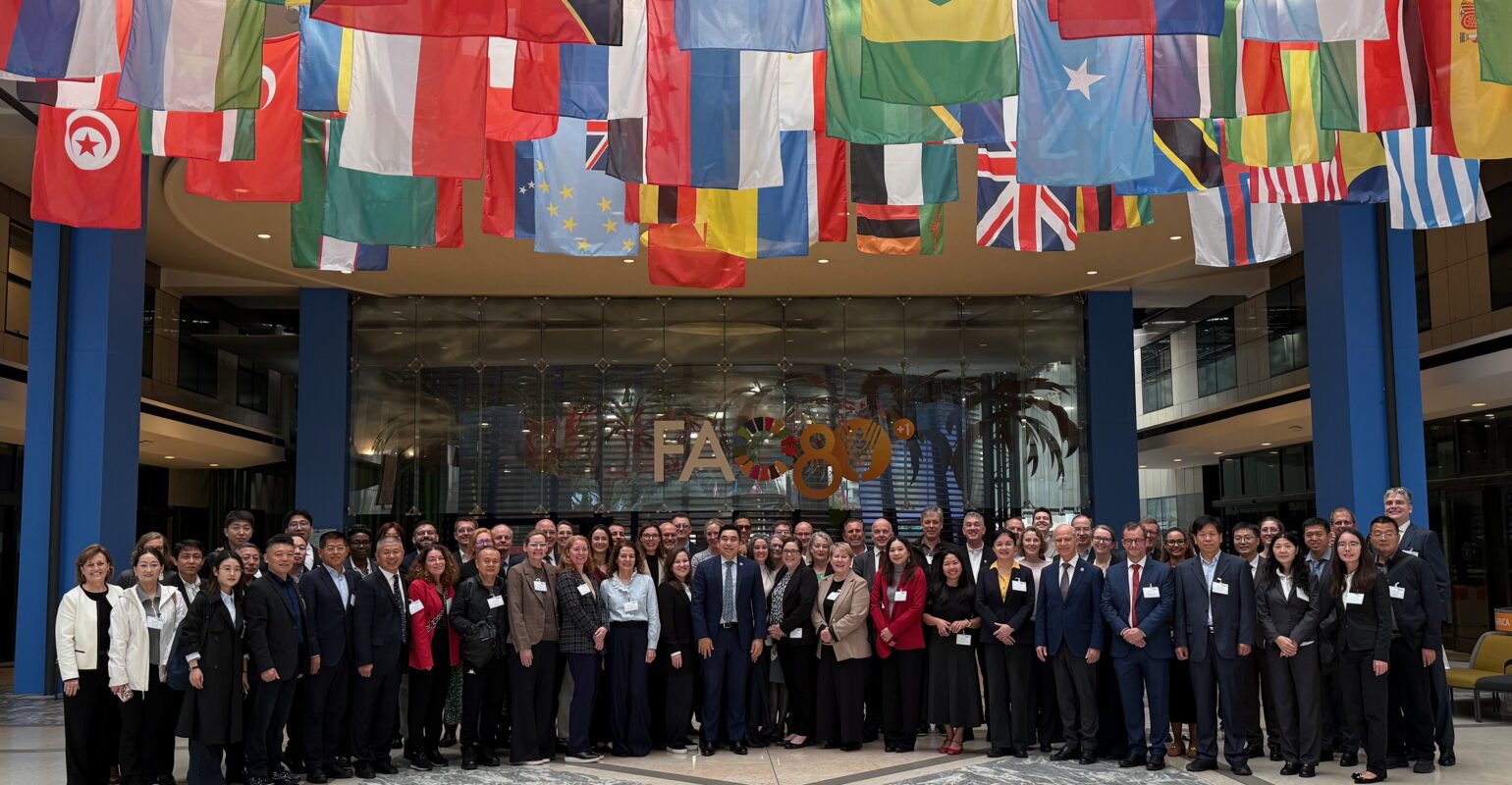
Rome, Italy – The International Feed Industry Federation (IFIF) and the Food and Agriculture Organization of the United Nations (FAO), reaffirmed their longstanding partnership and shared commitment to advancing safe, nutritious and sustainable animal feed as a key contributor to global food security and the sustainable transformation of livestock systems at their 25th Annual Meeting at FAO Headquarters in Rome from 11-13 November 2026.
The meeting brought together representatives from FAO, the global feed industry, national and regional feed associations, and technical experts to review progress under the FAO–IFIF joint work plan, exchange knowledge and identify priorities for future collaboration.
This year’s meeting also featured a high-level strategic dialogue between FAO and senior leaders from IFIF member companies and associations, focusing on the future of sustainable livestock and feed systems. The discussions highlighted the importance of public–private cooperation, innovation and science-based solutions to address global challenges and objectives, including food security, environmental sustainability, public and animal health.
Dr. Thanawat Tiensin, FAO Assistant Director-General and Director of the Animal Production and Health Division, emphasized the importance of the partnership:
“The sustainable transformation of livestock systems is essential to achieving global food security, improving nutrition and building more resilient agrifood systems. The feed sector plays a critical role in this transformation by contributing to animal health and welfare, improving resource efficiency and reducing environmental impacts.
Our longstanding collaboration with IFIF demonstrates the value of strong public–private partnerships in advancing science-based solutions and practical action. By working together, we can strengthen feed safety, promote innovation and support more sustainable livestock production, contributing to FAO’s vision of better production, better nutrition, a better environment and a better life, leaving no one behind.”
Constance Cullman, Chair of IFIF, welcomed the opportunity to strengthen strategic cooperation and advance shared priorities with FAO:
“For over 20 years, IFIF and FAO have built a strong and effective partnership based on shared priorities and concrete action. As we look to the future, the global feed industry has an essential role to play in supporting food security, improving animal health and welfare, and contributing to more sustainable and resilient livestock systems.
Our 25th Annual Meeting, together with the strategic dialogue with senior industry leaders, provides an important opportunity to strengthen our collaboration with FAO, align our priorities and accelerate practical solutions. Through initiatives such as IFIF’s Road to 2050, we are demonstrating how the feed sector can contribute to addressing global challenges and shaping the future of sustainable food production.”
Daniela Battaglia, Livestock Production Officer at FAO, highlighted the value of continued cooperation:
“The longstanding collaboration between FAO and IFIF demonstrates the importance of working together to strengthen feed safety, improve animal nutrition and support the sustainability of the livestock sector. The feed sector has a vital role to play in addressing global challenges and objectives, from improving resource use efficiency and environmental protection to promoting animal health and welfare to containing the antimicrobial resistance threat.
FAO looks forward to continuing this partnership, building on our joint activities and advancing practical, science-based solutions that contribute to sustainable and resilient agrifood systems.”
Alexandra de Athayde, IFIF Executive Director, added:
“Our collaboration with FAO is a cornerstone of IFIF’s work and has delivered important results over the past two decades, from advancing feed safety and regulatory cooperation to promoting sustainable feed production and animal nutrition.
This year’s meeting provided an excellent opportunity to review our joint achievements, exchange knowledge and identify priorities for future action. We look forward to continuing our close cooperation with FAO and our members to translate shared priorities into concrete initiatives that support the global feed sector and sustainable livestock transformation.”
Key Meeting Highlights and Initiatives Discussed
The 25th IFIF–FAO Annual Meeting featured updates on joint activities and key initiatives, highlighting the importance of continued collaboration:
- FAO–IFIF Strategic Dialogue: Senior leaders from IFIF member companies and associations engaged with FAO Director-General and officers in a high-level discussion on shaping the future of sustainable livestock and feed systems, identifying opportunities to strengthen public–private collaboration and advance shared priorities.
- IFIF Road to 2050: IFIF presented its Road to 2050 initiative and Systems Map, highlighting the interconnected challenges and opportunities facing the global feed sector and its role in supporting food security, resource efficiency and sustainable livestock transformation.
- Feed Safety and Regulatory Cooperation: Participants reviewed developments in Codex Alimentarius, the IFIF Regulatory Committee and the International Cooperation for the Convergence of Technical Requirements for the Assessment of Feed Ingredients (ICCF), highlighting the importance of science-based regulation, regulatory convergence and international cooperation.
- Scientific and Technical Cooperation: FAO presented its work on Reference Centres for Animal Nutrition and Feed, Feedipedia and the FAO Database of Emission Factors in Feed, highlighting the importance of scientific expertise, reliable data and knowledge sharing to support sustainable feed production.
- Sustainability and Environmental Performance: IFIF and FAO discussed progress under the Livestock Environmental Assessment and Performance (LEAP) Partnership, including the launch of the Technical Advisory Group (TAG) to revise the LEAP Guidelines on Environmental Performance of Animal Feed Supply Chains, with its kick-off meeting held at FAO headquarters in Rome on 11 November 2026. Discussions also covered the Global Agenda for Sustainable Livestock (GASL) and the implementation of FAO’s Global Plan of Action for Sustainable Livestock Transformation.
- Animal Nutrition and One Health: IFIF presented its work on nutritional innovation and the contribution of animal nutrition to animal health and welfare. FAO provided updates on its Reduce the Need for Antimicrobials on Farms for Sustainable Agrifood Systems Transformation (RENOFARM) initiative and the contribution of animal feed to the circular bioeconomy.
- Global Feed Industry Developments: Representatives from Canada, Australia, and China shared perspectives on regional feed industry developments, challenges and opportunities.
Ongoing Partnership and Future Collaboration
Since signing their Memorandum of Understanding in 2005, IFIF and FAO have worked closely together to strengthen feed safety, promote sustainable livestock production and advance capacity building and knowledge sharing worldwide.
The meeting also provided an opportunity to review the FAO–IFIF joint work plan for 2026 and discuss priorities for 2027 and beyond, reaffirming the shared commitment to practical cooperation on feed safety, sustainability, animal nutrition and the sustainable transformation of livestock systems.
IFIF and FAO will continue to build on their longstanding partnership to advance science-based solutions and strengthen the contribution of the global feed sector to sustainable and resilient agrifood systems.
About IFIF
The International Feed Industry Federation (IFIF) is made up of national and regional feed associations, feed related organizations, and corporate members from around the globe, representing over 80% of the feed production worldwide. IFIF provides provide a unified voice and leadership to represent and promote the global feed industry as an essential participant in the food chain that provides sustainable, safe, nutritious and affordable food for a growing world population. For more information on IFIF please visit www.ifif.org or contact Alexandra de Athayde, Executive Director, at info@ifif.org.
ENDS / Issued by: IFIF


 Latest News
